How to Finger Knit a PERFECT Chunky Blanket (Braided Edges, No Gaps + Any Size!)
Finger knitting is one of those things that looks fancy, but is actually super easy, relaxing, and incredibly satisfying once you get going.
The problem is… a lot of finger knit blankets end up looking a little rough.
Gaps and holes. Wobbly sides. Corners that aren’t quite corner-y enough.
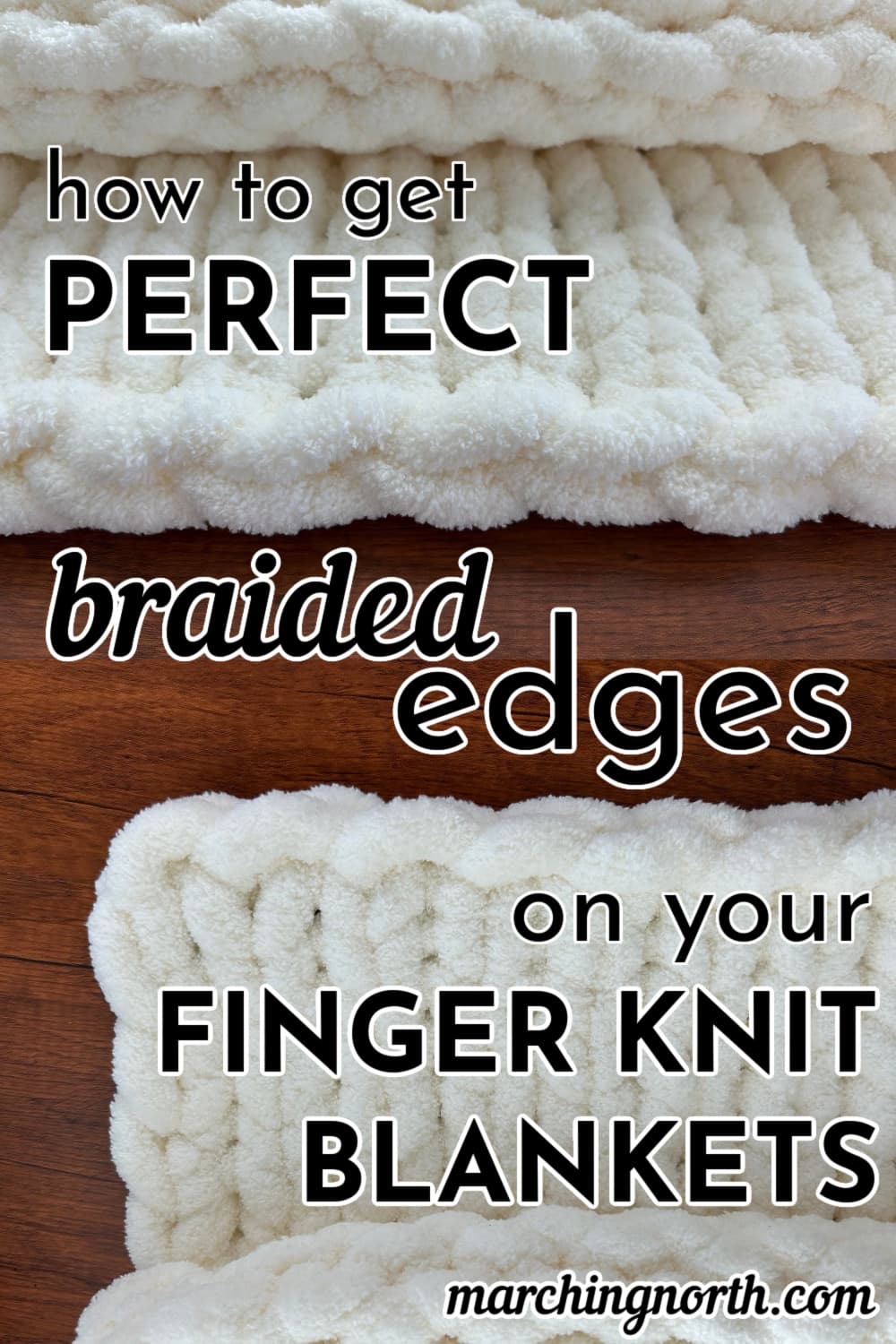
So, in this tutorial, I’m showing you my go-to method for making a chunky finger knit blanket that looks beautiful and finished… with clean, braided edges all the way around and no weird gaps or holes.
Plus, I’ll show you how to make it any size you want.
Don’t forget to pin this for later!
(This post may contain affiliate links. If you click one and make a purchase, I may receive a small commission at no extra cost to you. Read the disclaimer here. Thank you for your support!)
Instead of telling you an exact stitch count or row number, I’m gonna show you:
- how to control the width and length yourself
- how to add new yarn when you run out or for color changes (3 different options)
- how to keep your stitches nice and snug to avoid a holey blanket
- and how to make ALL of your edges look amazing.
If you’d really prefer a set stitch count, I have a couple patterns that include those that are linked below 😉
Whether you’re making a cozy throw, a baby blanket, or something big enough to cover your king sized bed… this method will work for you.
Let’s get started!
More Free Jumbo Yarn Patterns
Check out these other free BIG yarn patterns available on my website:
- How to Finger Knit a Chunky Blanket Fast! (Free Pattern!)
- How to Knit a Ribbed Finger Knit Blanket (Free Pattern!)
- Easy Round Finger Knit Throw Pillows (Free Pattern!)
- Chunky Square Finger Knit Pillow (Free Pattern!)
- Cozy Free Crochet Pillow Cover Pattern (Removable!)
- Free {Super Bulky} Crochet Throw Blanket Pattern
How to Make a PERFECT Finger Knit Blanket in Any Size – Step-by-Step Tutorial
Supplies You’ll Need
- Jumbo [size 7] yarn (I used Bernat Blanket Big) – 7 skeins is perfect for a good sized throw blanket (P.S. — you’ll save a bunch if you grab it when it’s on sale!)
- sharp scissors
- lighter (optional, to join yarn with the lighter method)
Notes
- Difficulty Level: Super Easy
Size Options
One of the best parts of these finger knit blankets is how easy they are to make whatever size you want.
Figure out the width you want your blanket to be, make your starting chain that long, plus an inch or two, and then make rows until it’s your desired length. So easy!
If you’re not sure what size you want your blanket to be, you’ll find some standard blanket sizes to work with in the table below.
You’ll just make your chain as long as the first number, then make rows until it’s as long as the second number:
| Blanket Type | Size in Inches |
|---|---|
| Baby Blanket | 42″ x 52″ |
| Throw Blanket | 54″ x 66″ |
| Twin (Reg & XL) | 66″ x 95″ |
| Full | 80″ x 90″ |
| Queen | 90″ x 100″ |
| King | 108″ x 100″ |
| Cal King | 104″ x 108″ |
A Note About Size & Stitch Multiples
If you’re using basic knit stitches for every row, there is no stitch multiple to worry about.
You can stop your foundation chain whenever it’s the width you want. Super simple.
If your pattern has ribbing, or anything that requires a certain number of stitches, then you will need to pay attention to the stitch multiple for that pattern when making your foundation chain.
For example, in my ribbed finger knit blanket pattern, the stitch multiple is 5 + 3. That means your starting chain would need to be any multiple of 5, plus 3 more chains.
So, you can’t quite get as granular in the width customization with a stitch multiple, but you can still get pretty close. As long as the finished width is as wide or wider than what you’re going for, you should be good.
For a simple knit-only blanket though, you’re free to keep things flexible.
Video Tutorial
Check out the tutorial video for this project on my YouTube channel, and don’t forget to subscribe!
New Gradient Version!
I made this blanket again following these steps, but this time I used a gorgeous gradient yarn called Bernat Blanket Extra Thick Perfect Phasing. I used the color Deep Navy, and it turned out so pretty!

I made another video for this version, and I’ll embed it down below under the tutorial. Be sure to check it out!
Instructions
Step 1: Make a Slip Knot and Your Starting Loop
We’re going to start by making a slip knot in the starting end of the yarn.
Loop the yarn around your hand, then reach you fingers under the yarn on the back of your fingers, grab the yarn and pull up a loop.
Slide your fingers out of the loop, then pull on the loop and both ends of the yarn to tighten up the knot.
Adjust the loop so it’s about 2 inches long. You want to be able to fit 3 fingers in the hole, but no more so that it’s pretty snug around those 3 fingers.
Step 2: Foundation Chain
Reach your 2 pincher fingers through the starting loop you just made, grab the working yarn and pull through another loop the same size.
Continue making loops like that until the chain is the width you want your blanket to be. (Or however many chains the pattern you’re following says to do.)
Remember to make your loops all the same size, and just big enough to fit 3 fingers into.
Measure your starting chain up to the second to the last loop. That will be approximately how wide your blanket is going to end up.
Your starting chain loops will be slightly larger than your main knitting loops for the rest of the blanket.
Step 3: Knitting the First Row and Creating a Braided Starting Edge
OK this is the first step to getting your beautiful braided edges.
Instead of working our first row into the sides of the foundation chains, we’re going to flip our foundation chain over and work the first row into the back bumps of the chains.
The back bump is the part of the chain on the back side that goes across the center of the chain.
So to start, flip your foundation chain over to the back side.
You’re going to skip the first loop (which is the last foundation chain loop you made). Don’t worry, we’ll come back to it later.
Then, insert your pincher fingers under the back bump of the second chain from bottom to top (your fingers will be pointing away from you), grab the working yarn and pull up a loop.
This time you want the loops you pull up to be smaller, about 2 inches tall works well.
Continue that all the way across the foundation chain.
Make the very last loop at the end of the row slightly larger than the other loops. I’ll explain why in a minute.
Step 4: Knitting Back Across and Continuing On
Now that you made it to the end of the row, it’s time to turn around and knit back in the other direction.
And this is where we do our next trick to get those clean, braided sides for our blanket.
Each row of your blanket, you’ll do two things:
- Make the last loop of each row slightly larger than the others
- When you turn and knit back across, you’re going to skip the first loop
That skipped loop is the same loop you intentionally made larger at the end of the previous row.
Here’s why we’re doing that:
- Making the last stitch a smidge larger prevents the edges from getting tight and cinched up
- Skipping the first stitch of each row creates a consistent braided edge down both sides of your blanket
You’ll knit into that skipped stitch at the end of each row, so it gets worked eventually. But doing it this way just gives your blanket a neater edge.
So just go forth and knit however many rows you can before you run out of yarn. Which brings us to our next step…
Step 5: Adding on More Yarn (3 Options)
At some point, you’ll need to add more yarn. When and how you do that depends on your blanket design and your personal preference.
When to Add Yarn
- If your blanket has stripes: At the start of a row for a clean color change
- Solid one color blanket: Wherever you want
Three Ways to Join New Yarn
There’s no single “right” way to join yarn when finger knitting, so I’m showing three options. Use whichever one feels best to you.
1. Lighter Method (aka Danger is My Middle Name ?)
This method is quick, easy, and you don’t have any ends to weave in or knots to contend with. That being said… it involves fire. And melting plastic. Proceed at your own risk.
NOTE: This only works with fluffy, polyester yarn that has a center plastic cord that holds it all together.
Here’s how to do it:
Let’s assume you’ve knitted all the rows needed of the first color, and you’re ready to change colors at the start of a row.
Undo the last stitch you did of that previous row. Now you’re going to cut the yarn right where it’s coming out of the next stitch over.
Now go ahead and pull another loop out so it’s easier to work with, and grab the yarn tail of your new yarn color.
This polyester yarn has a center core that we’re going to melt together. So grab a lighter and make sure you’re in a well ventilated area.
Holding those two yarn tails close together, light one of them (or both if you’re feeling wild), then quickly and CAREFULLY mash them together.
It cools down pretty quick, so then you can kind of roll the join between your fingers or palms so you don’t get a big hard plastic-y part there.
Give it a good pull (you can be a bit aggressive) to make sure it’s not coming apart, and then re-knit the stitches you undid.
Then go back and re knit the stitches you took out at the end of the row.
The last stitch will be done with the new color of yarn (and it counts as the first stitch of the next row.)
2. Basic Knot + Weaving in Ends (aka Danger is NOT My Middle Name ?)
If you don’t want to do the lighter method, but you do want to change colors at the start of a row, this is a good option.
Here’s how to do it:
At the start of the row where you want to change colors, just drop the yarn you were using, and make the first stitch with the new color of yarn, leaving several inches of a tail.
Make 5 or 6 stitches to anchor the new yarn in place, then go back and cut the old yarn, leaving a tail as long as the new yarn tail, and tie those tails together in a knot right up close to the loops.
Don’t pull too tight so that the loops get pulled out.
Then go back to knitting and you can weave those tails in on the back side of the blanket later.
NOTE: Before you tie the knot, you can cut some of the fluff off of the tails so they’re way skinnier, and then when you tie the knot and weave them in it’ll be less noticeable.
3. The Magic Knot ?
The magic knot is another knot method you can use to add on more yarn, but I really only use this method for one color blankets.
The reason being that it’s kind of hard to precisely control where the knot lands, and it’s just more trouble than it’s worth for color changes that need to be in a specific spot.
But for one color blankets, it’s a piece of cake – no fire necessary AND no ends to weave in!
Here’s how to do it:
Make sure you have a yarn tail from the yarn you’re running out of that’s at least 7 or 8 inches long.
Lay your first yarn tail (the one that just ran out) in front of you, then grab the tail of your new skein of yarn.
Cross the new yarn tail over the old yarn tail.
Take the new yarn tail and tie it around the old yarn tail, sorta close to the base, or where it’s coming out of your blanket.
Now, take the end of the OLD yarn tail and tie it around the NEW yarn tail. This knot will be closer to the skein than the first know was.
Now you’ll have 2 knots and a bit oval of yarn tied together.
Pull on the old yarn and the new yarn on either side of the knots until the two knots slide together in the middle.
Give it a good tug so they’re really mashed together (but don’t pull so hard that you snap the yarn.)
Now grab your scissors and cut the yarn tails off right next to the knot.
Don’t worry, it won’t come undone. (That’s the magic! ?)
The knot is kinda huge at this point, but since this is super fluffy chenille yarn, we can give it a haircut.
Carefully cut the excess fluff off of the knot, being careful NOT to cut the inner cord that actually holds the yarn together.
Give the knot one more tug to make sure it’s good, and if so, yay! It’s time to keep on knitting.
(If you do accidentally cut the inner cord and the knot comes apart, don’t worry, you can just do it over again. It happens to me sometimes, too.)
The knot will blend in with the rest of the blanket, and there’s a good chance you can get it to land on the back side of the blanket where you really won’t ever see it.
Step 7: Finishing the Blanket with a Braided Edge
Alright, my friend! We made it all the way to the end of the blanket! Now lets finish this thing off with a beautiful, finished edge to match all the other edges.
Here’s how to do it:
First off, just know it doesn’t matter which side you start from for your last row, it’s done the same way, but in the other direction.
Unlike all the other rows we did, this time we ARE going to knit into the first stitch of the row. And make your loops a bit bigger, too. So you can fit 3 fingers inside.
Ok, so knit the first stitch, then knit the second stitch.
Stick your pincher fingers into the first loop, grab the second loop and pull it through the first loop.
Knit the next stitch, then stick your fingers through the previous stitch, and pull the new stitch through.
Repeat that going all the way down the row until you reach the last stitch and you have one loop sticking up.
Cut the yarn, leaving a tail that’s about 6 inches long or so, and pull the tail through that last loop.
Pull it to tighten up the knot.
Done!
Step 8: Cleanup and Finishing Moves
Now that the blanket is all knitted, all you have to do is weave in any yarn tails you might have.
No matter what, you’ll have to weave in your starting and ending tails. And if you did the basic knot color change, you’ll need to deal with those ends too.
Once you weave them in under a few stitches on the back side of your blanket, just cut the excess yarn off and you’re officially done!
New Gradient Version Video
Here’s what I used for this one:
- Bernat Blanket Extra Thick Perfect Phasing in the color Deep Navy
- I used 4 skeins. These are 600g each, which is roughly double a regular Bernat Blanket Big skein, so if you’re grabbing the 300g size instead you’ll want 8.
- Finished size: 52″ x 64″
The best part is that you don’t have to plan any of the color changes. The yarn fades from white to blue all on its own. I love it! And this yarn is crazy soft.
The one trick: match the color at each join
When you run out of a skein, don’t just grab the new one and start knitting with whatever end you grab first. Do this instead:
- Look at the color your old skein ran out on.
- Grab the next skein and figure out if the color you ran out on is on the inside or outside of the skein. If it’s the outside, use the outside tail. And if it’s the inside, find the center pull.
- Join that end with the lighter trick (or a knot) and keep on knitting!
That way you’ll get a beautiful gradient effect going back and fourth instead of a hard line color change.
In Conclusion
I hope you enjoyed this ultimate finger knit blanket tutorial! If you make one, I’d love to see how it turns out- be sure to share it with me on Instagram!
Looking for more yarny projects to try?